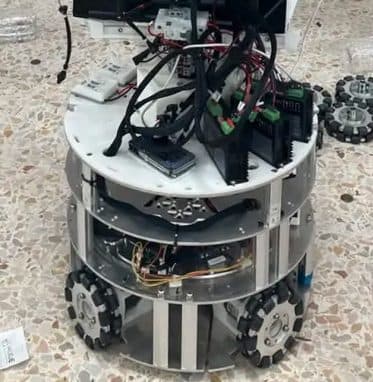
RoboticsJanuary 2026 - April 2026
3-Axis Cartesian Grasping Robot & Auto Parking
Vision-Guided Cartesian Gripper and LiDAR-Based Auto Parking
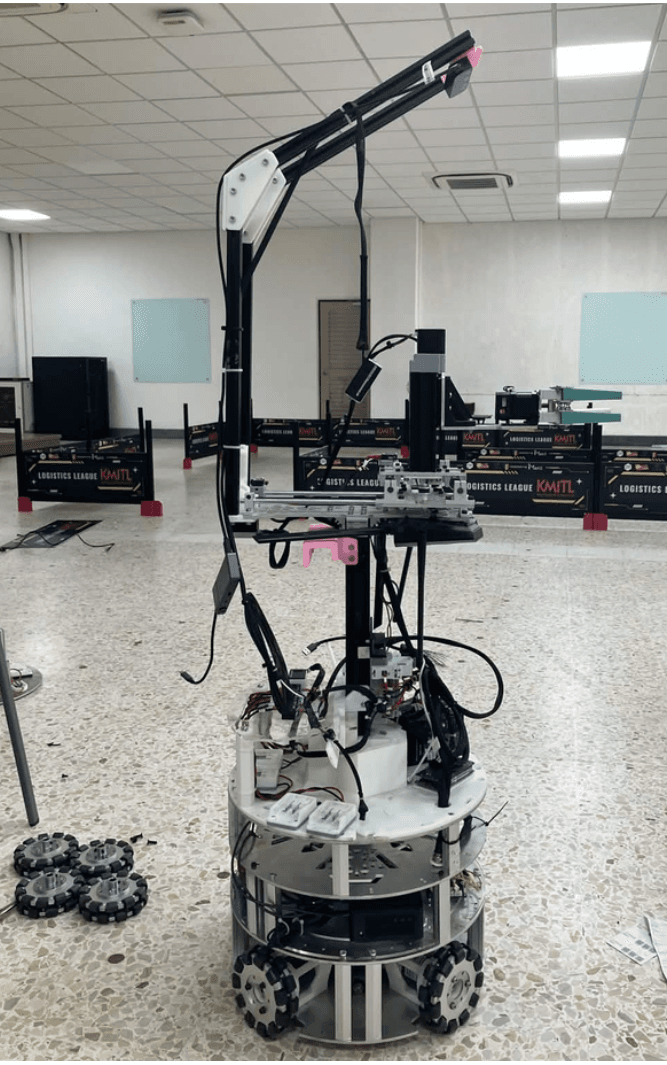
System Overview
This robot combines an omnidirectional base with a three-axis gantry for docking and object grasping.
LiDAR geometry guides parking; YOLO segmentation and RealSense depth locate objects for the gripper. A ROS2 state machine gates grasping on parking and homing readiness, then coordinates motion planning and serial hardware execution.
How it actually works
From LiDAR scan to grasp, in the real code
Step through the base's station detection and phased docking, then the gantry's depth filter, calibration matrix and execution gates, each running the project's own code.
Things to try
- In Dock in phases, set a large Start lateral offset and watch the bailout back the robot up.
- In Filter the depth, raise Background pixels in the mask past half and see the median jump.
- In Gate and move, switch Parking finished off: the target is dropped.
Built from the project's own code and documents.from code: A constant or rule copied from the project's repositoryfrom report: A value from the project's report or presentationsimulated: Computed in your browser by running the project's logic
How it works
Connect docking geometry to a physical grasp.
- 1
Scan the station
Filter forward LiDAR returns and fit the station face to produce distance, lateral offset, and heading error for docking.
- 2
Dock the mobile base
Progress through approach, heading correction, full alignment, and a stability gate before the final forward crawl.
- 3
Locate the object
Segment the RGB image, extract aligned depth, and transform the resulting camera-frame point into a gantry target.
- 4
Execute the grasp
After parking and homing gates pass, plan the gantry motion, transmit joint targets, and issue the gripper command.
Project Demo
The project's own demonstration footage.
Engineering features
Built a 3-axis Cartesian gantry with open-loop control, FSM, and deterministic waypoint generation.
Integrated YOLO segmentation with RealSense depth data (median, 30th percentile filtering) for precise 3D back-projection.
Implemented an Affine matrix-based Hand-Eye calibration to translate camera coordinates to the gantry seamlessly.
Developed LiDAR-based perception using geometric filtering, range gating, and RANSAC-based station face detection.
Engineered a phased docking controller with safety mechanisms (anti-windup, deadband filtering, bailout recovery) for the mobile base.
Inside the build
The control logic, integration and design decisions, one note at a time.
01Depth filtering at the object surface
The vision pipeline erodes mask edges, computes a median depth, and retains readings within 50 mm of that median. It selects the 30th percentile of the remaining depths to reduce background influence, then back-projects through the RealSense camera intrinsics to obtain a 3D point.
02Calibration and guarded gantry motion
Paired camera readings and gantry positions fit an affine transform by least squares. URDF joint limits, a spatial deadband, and a safe Z transfer constrain subsequent motion. An execution lock rejects overlapping requests; the serial bridge sends fixed-precision targets and appends an XOR checksum to each gripper packet.
03A controller for the final docking approach
RANSAC converts filtered station points into a line used for relative pose estimation. The docking controller changes active axes by phase, resets integral terms when needed, and checks alignment before committing. Deadband filtering, minimum crawl velocity, bailout recovery, and a perception watchdog address noise, motor deadzone, misalignment, and lost updates.
Build artifacts
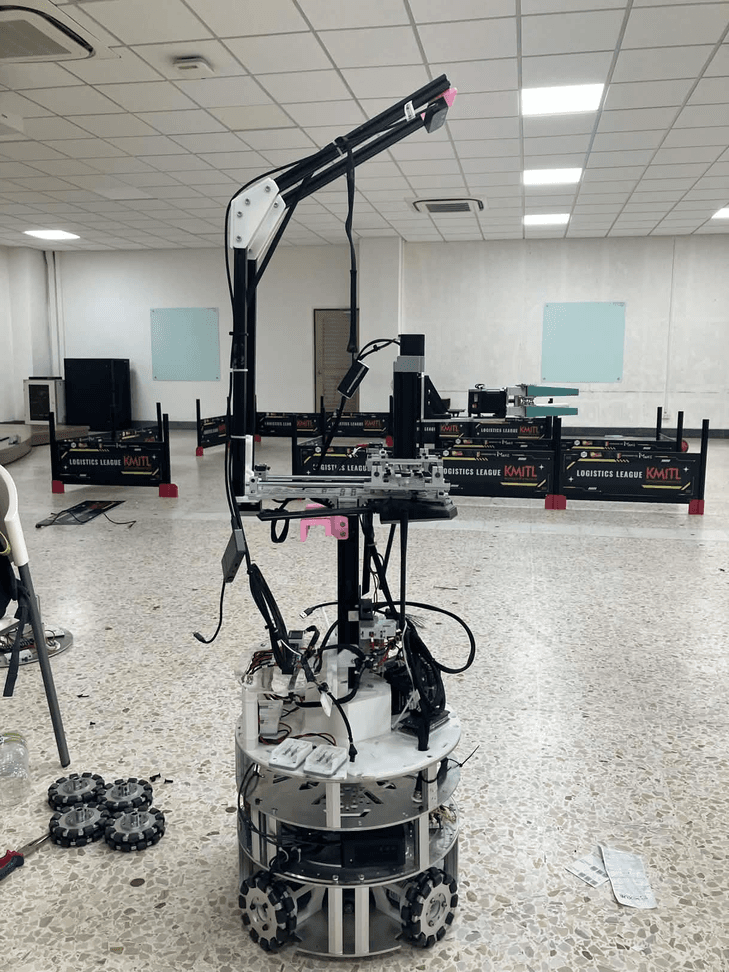
Figures taken from the project's own report or presentation.
Evidence & limitations
What the project documents show, and where each claim comes from.
Integrated hardware and control documentation
The presentation shows the assembled base and gantry, ROS2 node connections, and gated execution flowcharts. Its conclusion reports integration of vision-guided grasping and LiDAR parking under one state machine; a demonstration is linked in the supplied portfolio.
Segmentation evaluation artifacts
The results slide includes a normalized confusion matrix and an F1-confidence curve for the object-grab class. These are model evaluation artifacts. The parking repository's README records a best docking time of 7.4 seconds; no docking tolerance or end-to-end grasp success rate is reported.
- RoboCup project presentation
PDF pages 3-14: motion and docking; 16-24: hardware and vision; 27-29: results and conclusion.
- Parking source repository
- Robot workspace repository
- Project demonstration
Linked from the supplied portfolio.
Project Resources
The original documents behind this case study.
Hiring for robotics or embedded work?
I'm looking for internships. The résumé has the short version.