
System Overview
This desktop system turns uploaded apparel sales and stock files into SKU status, restock alerts, analytics, and Prophet forecasts.
It connects a Next.js/React interface to FastAPI and Supabase PostgreSQL, packaged with Electron, bringing stock information and restocking decisions into one interface for two apparel companies.
Tech Stack
Real-Time Analytics
Live inventory insights and performance metrics
AI Forecasting
Prophet-based demand prediction and optimization
Multi-Company
Support for multiple business entities
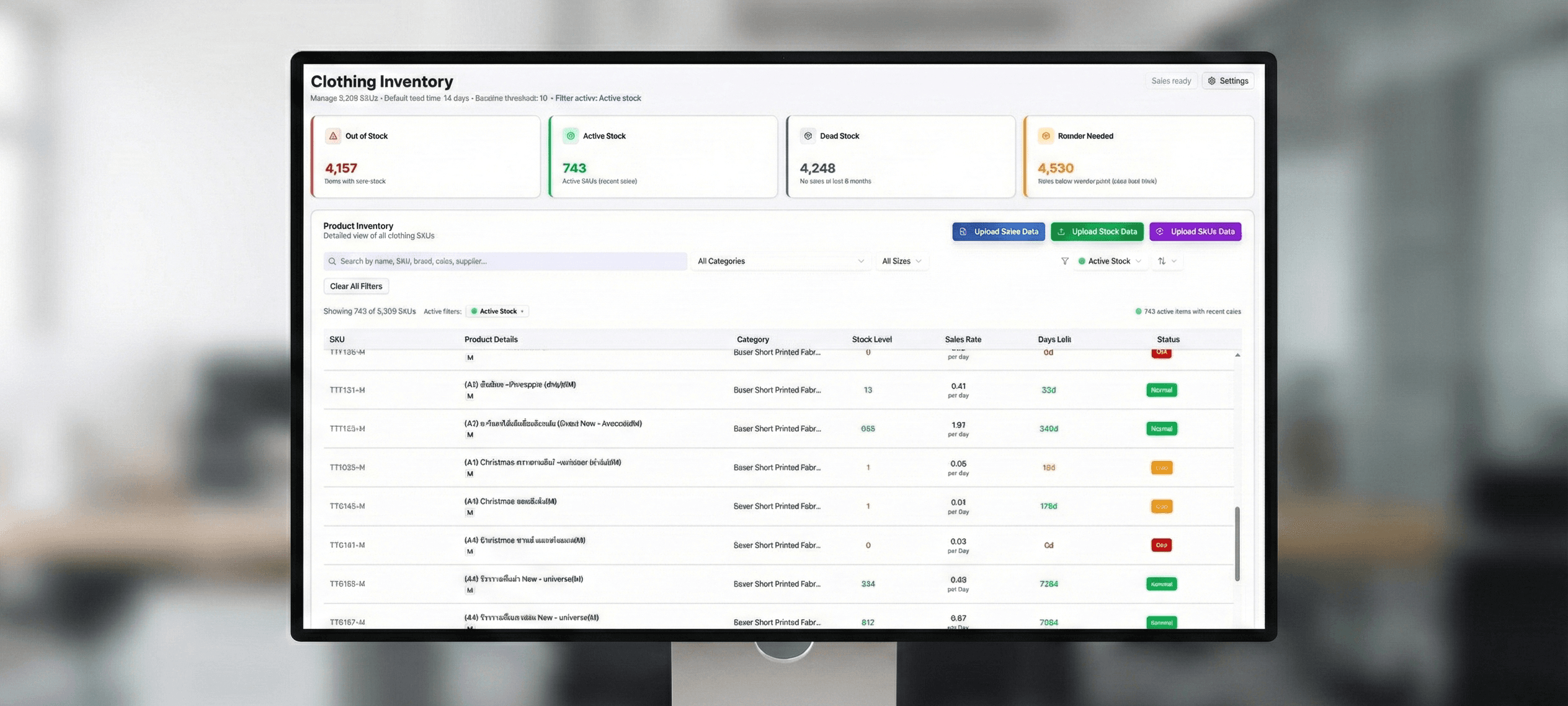
Project Demo
Engineering Features
Developed a full-stack inventory management and sales forecasting system for two partner companies.
Implemented ETL pipelines, low-stock alerting, and advanced SKU/sales analytics.
Built secure REST APIs, optimized PostgreSQL schemas, and integrated Prophet forecasting.
Delivered the system as a standalone desktop app and provided user onboarding.
How it works
Upload business data
Users provide sales, stock, and SKU files in the supported CSV or Excel formats to refresh the application data.
Clean and store records
The ETL pipeline cleans and validates uploads, then loads structured records into the sales, stock, and SKU tables.
Identify stock requiring attention
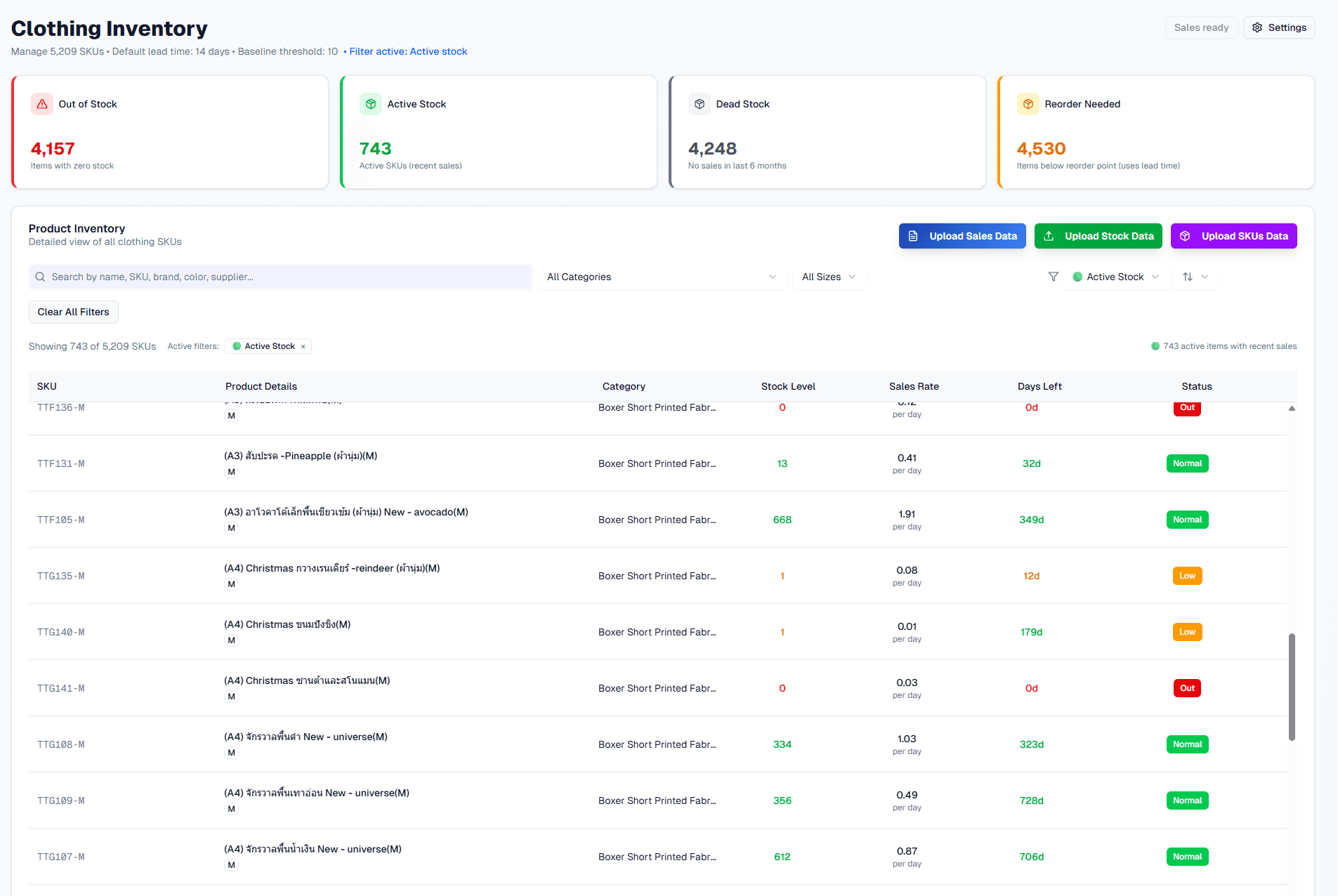
Calculate sales rates, remaining inventory days, and reorder status; display searchable SKU records, summaries, and low-stock notifications.
Explore demand forecasts
Select a SKU, category, or sales channel and forecast period to view Prophet predictions alongside inventory and sales analytics.
Build artifacts
Inside the build
Open a technical note to explore the control logic, integration, and design choices.
A database-backed desktop architecture
Sales, stock, and SKU records are stored separately in Supabase PostgreSQL after upload validation and normalization. FastAPI retrieves these records for analytics and forecasting. The Next.js/React interface presents inventory, product details, and prediction pages, with Electron packaging the interface as a desktop application.
Explainable reorder and stock-status rules
The reorder point combines a baseline threshold with lead time multiplied by daily sales rate. Remaining days are derived from stock divided by sales rate, while recent sales determine active or dead stock. Users can configure thresholds, lead time, and the sales windows used by these calculations.
Forecasting at the user's chosen level
Prophet processes historical sales prepared by the ETL pipeline, and the prediction page lets users choose SKU, category, channel, and horizon. Inventory summaries separately expose stock coverage, category trends, and SKU performance, giving forecasts context alongside the current stock position rather than presenting predictions in isolation.
Evidence & limitations
Implemented screens and company feedback
The report shows inventory, settings, analytics, product-detail, and prediction screens. It records upload processing, stock alerts, and positive feedback from both companies during testing and demonstrations. Its discussion also reports variable forecast accuracy, including high error in some cases, without supplying numerical evaluation results.
- Inventory management project report
PDF pages 10-15: problem and architecture; 18-25: implementation; page 18 (printed page 9), section 3.3: Lucky's database, frontend, and stock notification attribution; 26-28: results and limitations.
- Stockflow source repository
- Project demonstration
Linked from the supplied portfolio.
Want to see more work?
I have more projects across robotics, embedded systems, and software engineering.
View All Projects